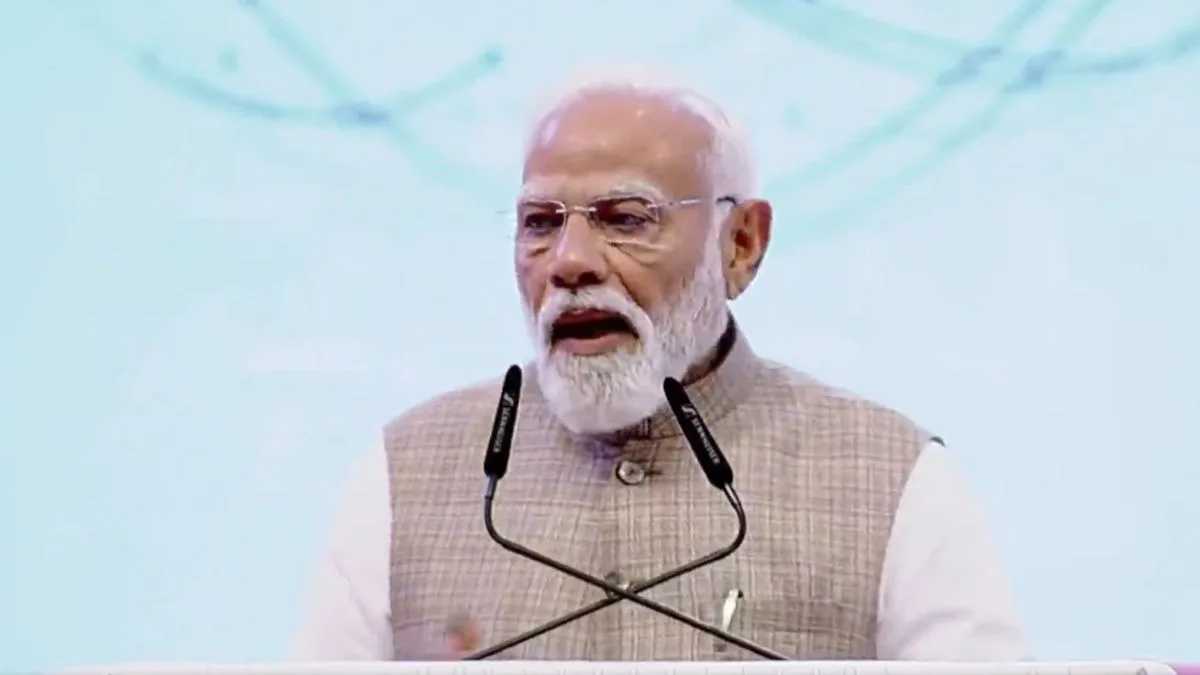
Prime Minister Narendra Modi will address the nation at 8:30 pm on Saturday in a high-stakes broadcast that comes in the wake of a significant legislative setback and amid mounting geopolitical concerns, positioning the speech as a potentially defining moment in the government’s political and policy messaging.
The televised address follows the collapse of the Constitution (131st Amendment) Bill, 2026, tied to the long-pending women’s reservation framework, which failed to secure the constitutionally mandated two-thirds majority in the Lok Sabha. The proposed law, aimed at reserving 33 per cent of seats for women and linked to a sweeping delimitation exercise that would have expanded the House’s strength to 816, fell short after a sharply polarised debate, with Opposition parties withholding support.
Advertisement
Although the Prime Minister’s Office has not formally disclosed the agenda, government sources indicated that the address is expected to cover the stalled legislation, the broader issue of women’s political representation, and the government’s next steps. The setback marks a rare instance of a major constitutional reform faltering at the final stage, highlighting deepening political divisions between the ruling alliance and the Opposition.
Senior officials suggested that Modi may use the national platform to directly appeal to citizens, portraying the bill as a landmark push for gender equity that was blocked by political considerations. “The people of India, especially women, deserve to know who stood in the way of their rightful representation,” a senior government source said, hinting at a sharper political pitch. Another official indicated that the Prime Minister could outline alternative strategies or renewed efforts to build consensus, even as the immediate legislative route appears uncertain.
The reform had been projected by the government as a historic corrective to structural imbalances in representation. India continues to lag behind several democracies in women’s participation in legislatures, with women accounting for just over 14 per cent of Lok Sabha members. However, the bill’s linkage with delimitation proved contentious, with Opposition leaders arguing that it could delay implementation and reshape the political balance among states.
The political fallout from the bill’s failure is expected to feature prominently in the Prime Minister’s remarks, particularly as the government seeks to sharpen its narrative ahead of upcoming electoral contests. Analysts say such an address is rarely routine. “A national broadcast at this juncture is typically aimed at resetting the narrative and mobilising public opinion,” observed a political analyst tracking parliamentary developments.
Compounding the domestic political turbulence are unfolding global concerns. Earlier in the day, Modi chaired meetings of the Cabinet Committee on Security and the Cabinet Committee on Economic Affairs, where discussions reportedly focused on rising tensions in West Asia and their potential impact on India’s energy supplies, food security, and economic stability. With global markets showing signs of volatility, the address may also seek to reassure citizens about the government’s preparedness to manage external shocks.
The convergence of internal political strain and external uncertainty has heightened anticipation around the speech. Whether Modi adopts a conciliatory tone aimed at consensus-building or sharpens his critique of the Opposition could significantly influence the political discourse in the weeks ahead. For now, attention is firmly fixed on the Prime Minister as he prepares to speak at a moment where legislative ambition, political contestation, and global anxieties intersect—an address that could set the tone for the next phase of governance and debate in the country.